I call them "Attribution Lies" — channels that look productive because they harvest demand created elsewhere. Here's how to spot them in your own account.
There's a particular kind of expensive mistake that's almost impossible to see from inside a platform dashboard.
It looks like success. The ROAS is strong. The conversion volume is solid. Your campaigns are hitting efficiency targets. And every month, you confidently allocate more budget toward the channels that are "working."
The problem? They're not working. They're just claiming credit for work done somewhere else.
In a recent podcast with Tier 11, one of the leading DTC performance agencies, I walked through a case study that shows exactly how much they cost, and what happens when you finally catch them.
What Is an Attribution Lie?
An Attribution Lie is a channel that appears productive in your reporting because it captures conversions — but didn't actually create the customer intent behind those conversions.
The clearest examples are brand search and bottom-of-funnel retargeting. Someone sees your YouTube ad. They think about your product for a few days. They Google your brand name and click the paid result. In Google's reporting: Google gets the conversion. In reality: YouTube created the customer. Google just collected the toll.
This matters enormously at scale. If you're making budget allocation decisions based on platform-reported ROAS, you will systematically starve the channels doing the real work and over-invest in the channels doing the credit-claiming. Every month, the imbalance compounds. Eventually, growth stalls — but the dashboards still look fine.
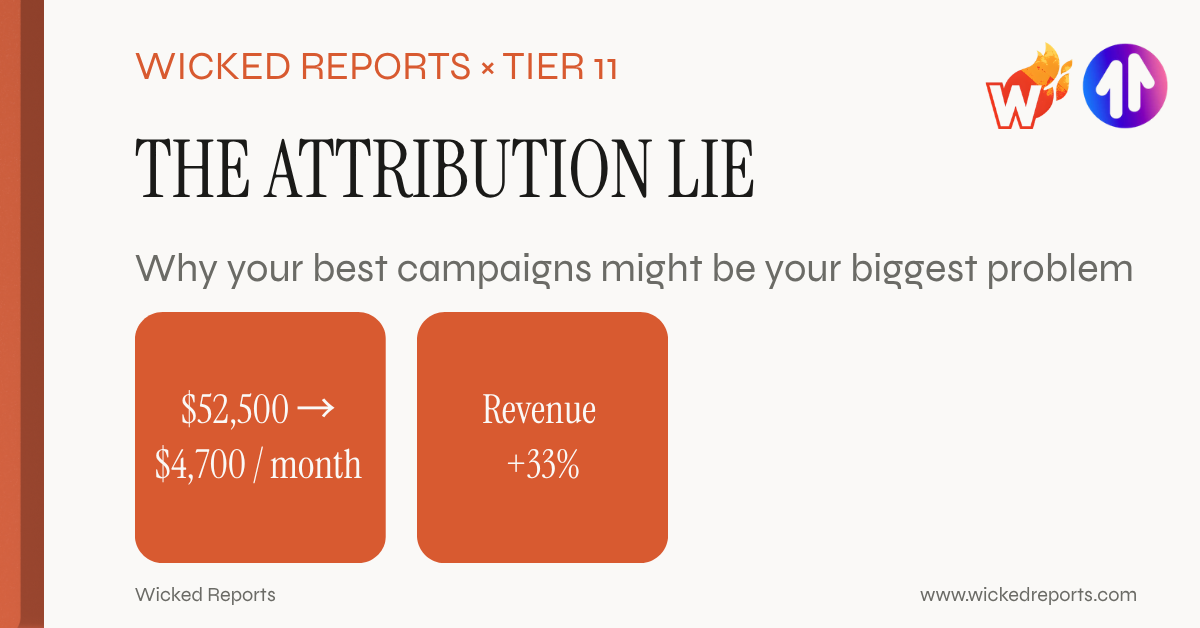
A Real-World Example: $52,500/Month to $4,700/Month
The DTC pet brand that Tier 11 and Wicked Reports worked with had been spending $52,500/month on Amazon advertising. Platform metrics showed it was productive. They kept spending.
The Tier 11 team had a hypothesis: what if Amazon wasn't creating customers — it was just intercepting them at the point of purchase?
So they tested it. Properly. They cut Amazon spend by 50%. Watched the data. New customer acquisition held steady at ~500/month. So they cut again. And again. And again.
By the end of four consecutive cuts, Amazon ad spend had dropped 91% — from $52,500 to $4,700/month. New customer numbers? Essentially unchanged. Amazon revenue? Up 33%.
They hadn't lost Amazon customers. They'd just stopped paying Amazon to take credit for customers their other channels had already created.
The same pattern held for Google Brand. A 95% cut in brand search spend led to only a 17% drop in clicks. The brand had been paying a significant premium to appear for searches that would have found them organically regardless.
Between these two channels alone, the team freed up tens of thousands of dollars per month — which was immediately redeployed into actual demand creation.
How to Spot Attribution Lies in Your Account
You don't always need to run a full incrementality test to get a sense of whether you have an attribution problem (though you should eventually). Here are some signals worth looking for:
Your bottom-of-funnel channels have suspiciously high ROAS.
Brand search and retargeting campaigns showing 8x, 10x, 15x ROAS should raise eyebrows, not celebration. People who already know and want your brand are cheap to convert — you're measuring the cost of the final step, not the cost of the journey.
Cutting bottom-of-funnel spend feels terrifying, even in small amounts.
If the thought of reducing your retargeting budget by 20% is anxiety-inducing, ask yourself why. What exactly are you afraid will stop happening? If you can't answer that clearly, that's worth investigating.
New customer growth is flat while blended ROAS looks healthy.
This is the clearest signal of all. A healthy business grows its new customer base. Retargeting-heavy accounts often show great blended metrics while quietly reducing the size of the new customer pool they're drawing from.
Your top-of-funnel campaigns get killed for poor ROAS.
If you're judging awareness or native campaigns by the same last-click ROAS standard as your retargeting campaigns, you're comparing apples to tax returns. They're doing a completely different job.
The Metrics That Expose the Lie
Standard platform ROAS will never show you Attribution Lies — because platforms measure what they can see, and they can only see activity inside their own walls. A customer who saw a Taboola native ad, then searched Google two weeks later, then clicked an email, then bought — that's four channels all claiming partial or full credit, with none of them showing you the full picture.
The metrics that actually expose attribution problems are:
nCAC (New Customer Acquisition Cost):
Isolates the cost of acquiring someone who has genuinely never bought from you. Not modeled. Not estimated. Based on first-party order and customer data. If this number is rising while your ROAS looks stable, you have an attribution problem.
New visitor rate by channel:
What percentage of the traffic a given channel drives is people who have never been to your site before? Native ads and broad social should be high (80%+). Retargeting and brand search should be low. If your "top-performing" channel has a 20% new visitor rate, it's not finding you new customers — it's recycling existing ones.
Incrementality:
The gold standard. Hold out groups, controlled experiments, real measurement of what would have happened without a given channel. Not available inside any platform natively — you need a measurement layer that sits outside the platforms themselves.
Wicked Reports was built to provide exactly this. First-party click paths, real order and customer IDs, and a framework (the 5 Forces model) that assigns the right attribution window and the right KPI to each campaign based on its actual job — not a one-size-fits-all last-click model.
What Happens When You Fix It
For the Tier 11 client, fixing the attribution layer and reallocating budget accordingly produced results across four consecutive months — including the two historically slowest months of the year for the brand:
- nCAC fell from $193 to $128 — a 34% reduction, hitting an all-time low
- New customers grew 25% (10,870 new customers acquired)
- Revenue grew 21.9%
- All of this on a 2.7% increase in total spend
And the channels that received zero additional investment — organic, email, Amazon — all grew too. That's what real demand creation does. When you bring genuinely new people into your ecosystem, the whole business benefits. You're not just moving conversions around. You're growing the pool.
The Bigger Picture
Attribution Lies are everywhere in digital marketing — and they're not going away. Platforms will always be incentivized to claim credit. Last-click models will always favor the final touchpoint. And as long as marketers are graded on platform-reported ROAS, they'll keep over-investing in channels that look efficient but aren't effective.
The way out isn't to stop using these platforms. It's to stop letting them grade their own homework.
You need a measurement layer that sits outside the platforms. One that starts with your actual customers — real order IDs, real people, real behavior — and works backwards to understand which channels actually created them.
That's the foundation of every good marketing decision. And it's what Wicked Reports was built to provide.
[🎧 Hear the full conversation with the Tier 11 team → PODCAST LINK]
Ready to see what your attribution is actually telling you? Book a live demo at wickedreports.com →
Wicked Reports is a first-party attribution platform that separates new customers from repeat customers at the campaign level — giving DTC brands and their agencies the data they need to make decisions that actually grow the business.